


Webinar retention is the percentage of registrants who stay engaged and watch through to the end of your session, and it is one of the clearest signals of whether your content, pacing, and structure are actually working. Getting people to register is only half the battle — the real challenge is keeping them there. This guide breaks down what webinar retention really means, why it matters more than raw attendance numbers, and a complete framework you can use to keep your audience engaged from the opening slide to the final call to action.
Marketers love to celebrate registration numbers, but registrations don’t pay the bills — engaged attendees do. You can fill a webinar with five hundred sign-ups and still walk away with almost nothing to show for it if most people drop off ten minutes in. That gap between who signs up and who actually stays is exactly what webinar retention measures, and it is one of the most overlooked metrics in the entire webinar funnel.
Improving this number is not about luck or a charismatic host alone. It comes down to deliberate choices made before, during, and after the live session. In this guide, we’ll walk through what drives people to leave early, what keeps them glued to the screen, and a step-by-step framework you can apply to your next event.
What Is Webinar Retention?
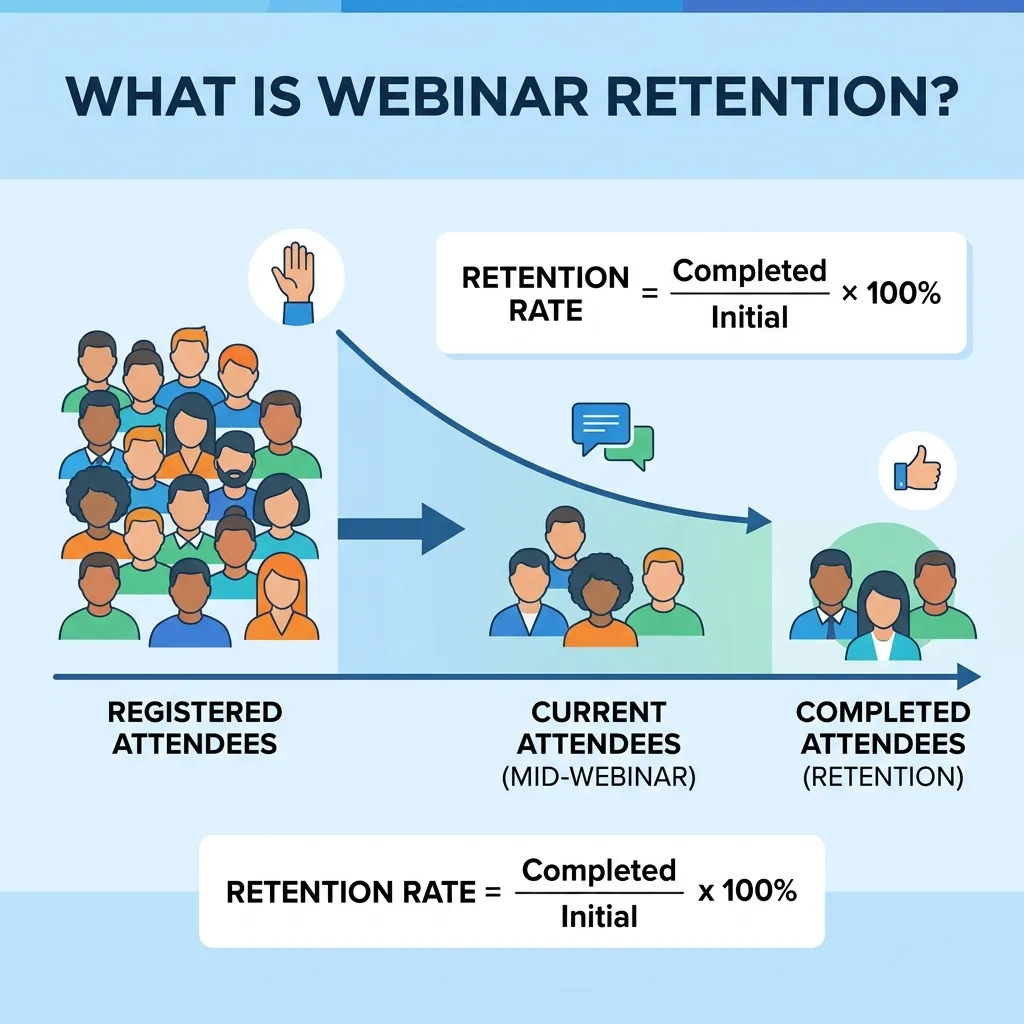
Webinar retention refers to how long attendees stay engaged during a live or recorded session, typically expressed as a percentage of the total scheduled runtime or as a webinar retention curve showing exactly when people drop off. It is different from your registration-to-attendance rate, which only tells you how many people showed up in the first place. Retention tells you what happened after they arrived.
A healthy retention curve is usually gradual, with most drop-off happening near natural breakpoints — after the introduction, before a Q&A segment, or once the core value has already been delivered. A poor curve looks like a cliff: a sharp, early drop within the first few minutes, which almost always points to a mismatch between what was promised in the invitation and what the session actually delivers.
Tracking this metric matters because it exposes problems that attendance numbers hide completely. Two webinars can have the exact same turnout and wildly different outcomes depending on how long people actually stuck around.
Why Webinar Retention Matters More Than Attendance
It’s tempting to treat a full registration list as success, but attendance without engagement rarely converts into pipeline or revenue. A tighter connection to audience loyalty and long-term engagement is where the real payoff lives, and our friends over at wompromotion’s guide to community marketing make a similar point about loyal communities: the value isn’t in how many people show up once, it’s in how consistently they stay engaged over time.
There are a few concrete reasons this metric deserves more attention:
- It predicts conversion. Attendees who stay until the offer or CTA are exponentially more likely to convert than those who leave beforehand.
- It reveals content problems early. A drop-off spike at a specific timestamp tells you exactly where your pacing, slide design, or messaging is losing people.
- It protects your sender reputation. Consistently low engagement across webinars can hurt how platforms and email providers view your future invitations.
- It compounds over a webinar series. People who finish one session are far more likely to register for and complete the next one, building a loyal recurring audience rather than a one-time crowd.
Webinar Retention vs. Webinar Attendance Rate
These two metrics are often confused, but they measure entirely different parts of the funnel. Attendance rate tells you what percentage of registrants actually joined the live session. Retention tells you what happened once they were there — how long they stayed, when they left, and whether they made it to the parts of the presentation that actually drive action.
A business can have a strong attendance rate and a weak webinar retention curve, which usually signals that the invitation and reminder sequence oversold the session relative to what it delivered. Getting the invitation messaging right still matters, of course — but it only gets people through the door. What keeps them in the room is a different set of skills entirely, and that’s what the rest of this guide focuses on.
The Complete Framework: How to Improve Webinar Retention

Improving how long people stay engaged is a process that starts well before you go live and continues after the session ends. Here is a practical, step-by-step framework.
Step 1: Set Accurate Expectations Before You Go Live
The single biggest cause of early drop-off is a mismatch between what was promised and what is delivered. If your invitation promises a tactical, hands-on walkthrough and the session opens with fifteen minutes of company history, people will leave. Be precise about what attendees will learn, and make sure the opening minutes deliver on that promise immediately.
Step 2: Win the First Five Minutes
Attention is highest at the very start and drops sharply if nothing valuable happens quickly. Skip the long introductions and lead with something concrete — a surprising statistic, a quick preview of what’s coming, or a real example of the outcome attendees can expect. The first five minutes largely determine whether someone commits to staying for the rest.
Step 3: Build In Interaction, Not Just Presentation
A one-way lecture is the fastest route to a dead room. Polls, live chat, and Q&A prompts give attendees a reason to keep their attention on the screen rather than switching tabs. Spacing these interactive moments every ten to fifteen minutes helps re-engage anyone whose attention has started to wander.
Step 4: Use Gamification to Sustain Engagement
Simple game mechanics — point systems, live leaderboards, small prizes for participation — can meaningfully extend how long people stay engaged, especially in longer sessions. Our guide on gamifying your webinars for better engagement and retention covers specific mechanics you can layer into an existing format without overcomplicating production.
Step 5: Personalize the Experience for Different Segments
Not every attendee is at the same stage of the buyer journey, and treating everyone identically leaves parts of your audience under-served and likely to disengage. Segmenting content, using dynamic polls based on audience role, or tailoring the closing offer to different attendee types keeps more of the room relevant to more people. For a deeper look at execution, see our guide on personalizing webinar campaigns for stronger engagement.
Step 6: Watch the Pacing and Cut the Dead Air
Long unbroken monologues, slow transitions, and awkward pauses are silent webinar retention killers. Tight pacing, a clear agenda shared upfront, and a host who moves the session along with energy all keep the room from going quiet. If a section of your presentation consistently correlates with drop-off, that’s a strong signal it needs to be shortened or cut entirely.
Step 7: Track Where People Actually Leave
You cannot fix what you don’t measure. Most webinar platforms provide a webinar retention curve showing exactly when attendees exit, and reviewing that curve after every session is one of the highest-leverage habits you can build. Our complete guide to webinar success metrics walks through which numbers to track and how to read them properly.
Step 8: Follow Up to Extend the Relationship Beyond the Live Session
Retention doesn’t have to end when the webinar does. A strong post-event follow-up sequence — recap emails, bonus resources, or an invitation to the next session — keeps the relationship alive for attendees who left early and reinforces value for those who stayed until the end. Our guide on webinar follow-up strategies to keep attendees engaged breaks down exactly how to structure that sequence.
Common Mistakes That Hurt Webinar Retention
Even experienced hosts make avoidable mistakes that quietly drain their audience throughout a session:
- Front-loading logistics instead of value. Spending the first several minutes on housekeeping before delivering anything useful gives early leavers every reason to go.
- Ignoring the chat. When attendees ask questions or comment and get no acknowledgment, engagement drops fast.
- One long block of content with no structure. Without clear segments or a visible agenda, attendees lose track of how much more time they’re committing to.
- Overselling in the invitation. If the promise in the invite doesn’t match the actual session, people leave the moment they notice the gap.
- No plan for the recording. If attendees know a full recording is coming regardless of whether they stay, some will simply drop off, particularly during less critical segments.
Measuring and Optimizing Webinar Retention Over Time
Improving this metric is rarely a one-time fix. It works best as an ongoing loop: run the session, review the webinar retention curve, identify the exact timestamps where people leave, adjust the content or pacing at that point, and test again on the next event. Over several sessions, this creates a feedback loop that steadily raises how long your average attendee stays engaged.
It also helps to think about engagement holistically rather than chasing a single number. The way wompromotion frames brand advocacy metrics is a useful parallel here — no single KPI tells the whole story, and the most reliable insights come from tracking several signals together rather than optimizing for one number in isolation.
Webinar Retention Benchmarks by Format
Not every webinar format should be judged against the same webinar retention bar. A 20-minute product demo naturally holds a higher percentage of its audience than a 90-minute panel discussion, simply because there is less time for attention to wander. Live, single-presenter sessions with heavy audience interaction tend to sit at the higher end of the retention spectrum, while longer multi-speaker events or dense technical webinars typically see steeper drop-off curves, especially past the halfway mark.
Rather than comparing your numbers to an industry-wide average that may not reflect your specific format, it’s more useful to build your own internal benchmark. Track webinar retention for every session you run over a quarter, segment by format and length, and use that internal baseline to judge whether a new tactic actually moved the needle. A 5-point improvement against your own historical average is a much more meaningful signal than hitting some generic number pulled from a blog post.
Tools and Technology That Support Better Retention

Most modern webinar platforms already surface the raw data you need — attendee timelines, engagement scores, poll participation, and drop-off timestamps. The challenge is rarely a lack of data; it’s turning that data into specific changes for your next session. A simple, repeatable review process works well: after every webinar, pull the webinar retention curve, mark the exact minute of any sharp drop, and cross-reference that timestamp against your script or slide deck to identify what was happening at that moment.
Beyond analytics, a few categories of tools consistently help extend how long people stay engaged: live polling and Q&A widgets, chat moderation tools that keep the conversation flowing without becoming distracting, and automated reminder and follow-up sequences that keep the broader audience relationship alive between sessions. None of these tools fix a weak presentation on their own, but layered on top of solid content and pacing, they compound the impact of everything else in this guide.
Audience loyalty built through consistent, valuable live events also tends to spill over into other channels. The way wompromotion describes podcast audiences building loyalty over time applies almost directly to a webinar series — attendees who consistently get value from your live sessions become far more likely to show up, stay, and eventually advocate for your brand elsewhere.
Conclusion
Webinar retention is ultimately a reflection of how well your content, structure, and delivery match what your audience actually came for. Set accurate expectations, win people over in the first few minutes, build in real interaction, and use the data from every session to sharpen the next one. Attendance gets people in the room, but webinar retention is what determines whether the time they spend there actually turns into pipeline, revenue, or a loyal recurring audience. Treat it as a metric worth optimizing every bit as much as registrations, and your webinar program will start delivering results that match the effort you put into filling the room.
Frequently Asked Questions
1. What is a good webinar retention rate?
Most well-run webinars retain somewhere between 40% and 60% of live attendees through to the end, though this varies by format, length, and industry. It is more useful to track your own trend over time than chase an arbitrary benchmark.
2. What is the difference between webinar retention and attendance rate?
Attendance rate measures how many registrants actually showed up; webinar retention measures how long those attendees stayed engaged once the session started.
3. When do most attendees drop off during a webinar?
Drop-off is most common in the first five minutes if the opening doesn’t deliver value quickly, and again near the midpoint of longer sessions if pacing slows down.
4. Does webinar length affect retention?
Yes. Shorter, tightly structured sessions generally retain a higher percentage of the audience than long-format webinars, especially when the content past the 30-minute mark isn’t clearly essential.
5. How can I track where people leave during a webinar?
Most webinar platforms provide an attendee timeline or webinar retention curve in their analytics dashboard, showing the exact minute each participant exited the session.
6. Do interactive elements actually improve retention?
Yes. Polls, live Q&A, and chat prompts give attendees active reasons to stay engaged rather than passively watching, and sessions with regular interaction tend to hold audiences longer than pure lecture-style formats.
7. Should I tell attendees a recording will be available?
It depends on your goal. Mentioning a recording can reduce no-show anxiety, but it can also encourage some live attendees to drop off early since they know they can catch up later.
8. How does gamification help with webinar retention?
Simple mechanics like point systems or live leaderboards give attendees an incentive to stay active and present throughout the session rather than multitasking or leaving early.
9. Can follow-up emails improve future webinar retention?
Yes. A strong follow-up sequence keeps your brand relevant to attendees who left early, and it builds the kind of ongoing relationship that leads to better retention on your next event.
10. Is webinar retention more important than the number of registrants?
Both matter, but retention is a stronger predictor of actual business outcomes, since it reflects genuine engagement rather than just interest at the point of signing up.
11. How often should I review my webinar retention data?
Ideally after every session. Reviewing the retention curve immediately while the format and content are still fresh makes it much easier to identify what to fix before your next event.
12. What’s the fastest way to improve webinar retention?
Tightening your opening five minutes to deliver value immediately is usually the single highest-impact change, since a strong start prevents the majority of early drop-off before it happens.














No Comments