



Webinar attribution answers a question every marketing team eventually has to face: did that webinar actually help close deals, or did it just look good on an attendance report? Webinars sit in an unusual spot in the B2B funnel — they’re rarely the very first touch a prospect has with your brand, and they’re rarely the very last touch before a deal closes either. That in-between position is exactly why attributing credit to them correctly is so difficult, and so important.
Get webinar attribution wrong, and you’ll either overinvest in an event program that isn’t actually driving revenue, or underinvest in one that’s quietly influencing every deal in your pipeline. This guide walks through how webinar attribution works, which attribution models fit different sales motions, and how to set up tracking that gives your team an honest answer.
This isn’t just an analytics exercise, either. The answer to “does our webinar program work” directly shapes budget decisions, headcount for event marketing, and how much time your team spends on content versus promotion versus follow-up. Getting attribution right turns that conversation from a gut-feeling debate into something you can actually defend with data in a board meeting or quarterly business review.
Why Webinar Attribution Is Uniquely Difficult
Most B2B buying journeys in 2026 involve multiple people, multiple channels, and multiple months before a deal closes. A single account might include an SDR manager who downloads a case study, a director who attends your webinar, and a VP who eventually takes a demo call — and figuring out which touchpoint deserves credit for the resulting deal is rarely straightforward.
Webinars make this harder still because they often influence deals without directly converting them. A prospect might attend a webinar, take no immediate action, and then convert months later through a completely different channel — while the webinar quietly did the work of building trust and educating them along the way. Simple last-click tracking misses this kind of influence entirely, which is exactly why dedicated webinar attribution matters.
Reviewing the complete guide to webinar success metrics is a useful starting point here, since attribution only works well when you’re already tracking the right engagement signals during and after the event itself.
Attribution Models: Which One Fits Webinars Best
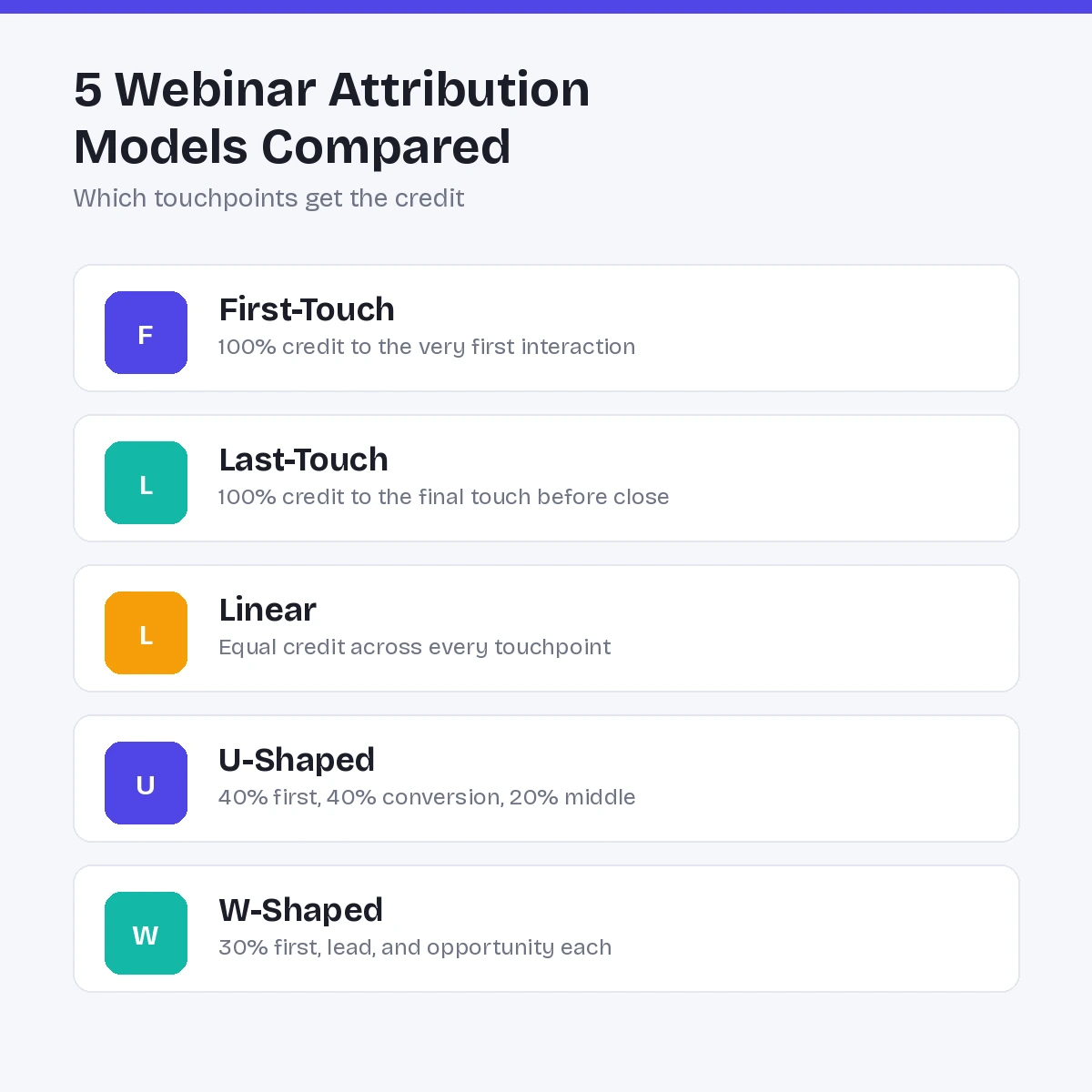
First-Touch Attribution gives 100% of the credit to the very first interaction a prospect had with your brand. This is simple to implement but tends to undervalue webinars that happen in the middle of a longer journey — even when that webinar was the moment a prospect actually got serious.
Last-Touch Attribution gives 100% of the credit to the final interaction before conversion. This works fine for short sales cycles with few channels, but it systematically undervalues webinars, since they rarely happen to be the very last thing a prospect does before signing.
Linear Attribution splits credit equally across every touchpoint in the journey. It’s simple and fair in a basic sense, but it treats a casual blog visit the same as a 45-minute webinar attendance, which rarely reflects reality.
U-Shaped Attribution assigns 40% credit to the first touch, 40% to the conversion touch, and splits the remaining 20% across everything in between — including webinars. This tends to undercredit webinars that happen mid-funnel but aren’t the final converting action.
W-Shaped Attribution extends this further, assigning roughly 30% credit each to the first touch, the lead-creation touch, and the opportunity-creation touch, with the remaining 10% spread across other touchpoints. For many B2B teams, this is the most realistic model for webinars, since it recognizes them as meaningful even when they’re neither the first nor the last interaction.
For deal volumes above roughly 200 per year with strong data quality, algorithmic or data-driven attribution — where machine learning assigns fractional credit based on actual statistical influence — is increasingly common, though it requires enough volume and clean tracking to produce reliable results.
Mapping the Multi-Touch Buyer Journey
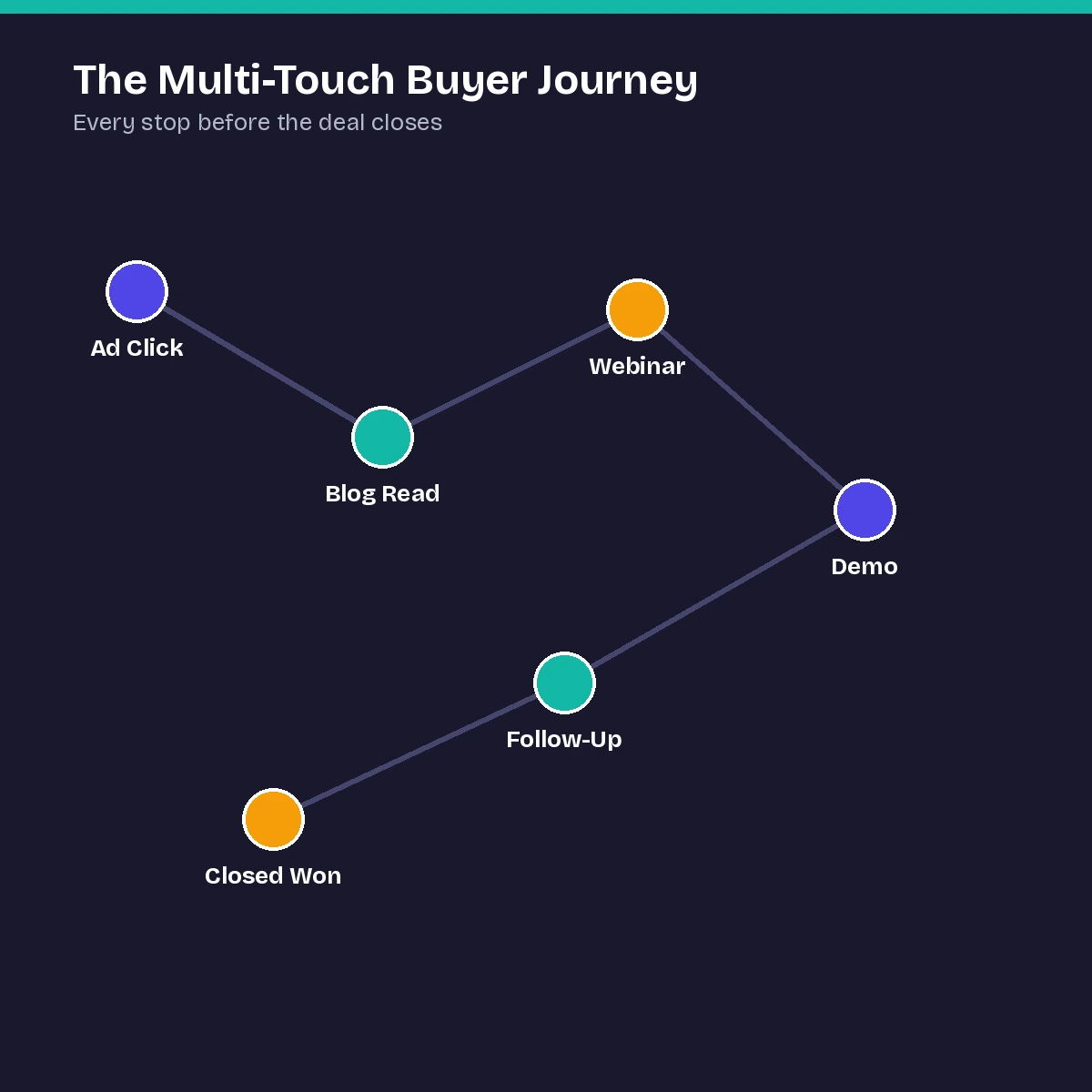
A typical 2026 B2B journey rarely runs in a straight line. A prospect might click a paid ad, read a blog post weeks later, attend your webinar, disappear for a month, request a demo, and receive several sales follow-ups before finally converting. Webinar attribution is essentially the practice of making sure that middle “attend your webinar” step gets fair credit in this winding path, rather than being invisible because it wasn’t the first or last stop.
This is also where account-based thinking matters. In B2B, the person who registers for your webinar and the person who eventually signs the contract are often different individuals on the same buying committee. A complete attribution setup needs to connect webinar attendance to the account level, not just the individual contact record, or you’ll miss influence that’s genuinely there simply because it “belongs” to a different person’s activity history. This is closely related to multichannel retargeting tactics for webinar leads, since retargeting campaigns built on accurate attribution data can re-engage exactly the touchpoints that mattered most in a given account’s journey.
Setting Up UTM Tracking for Webinars
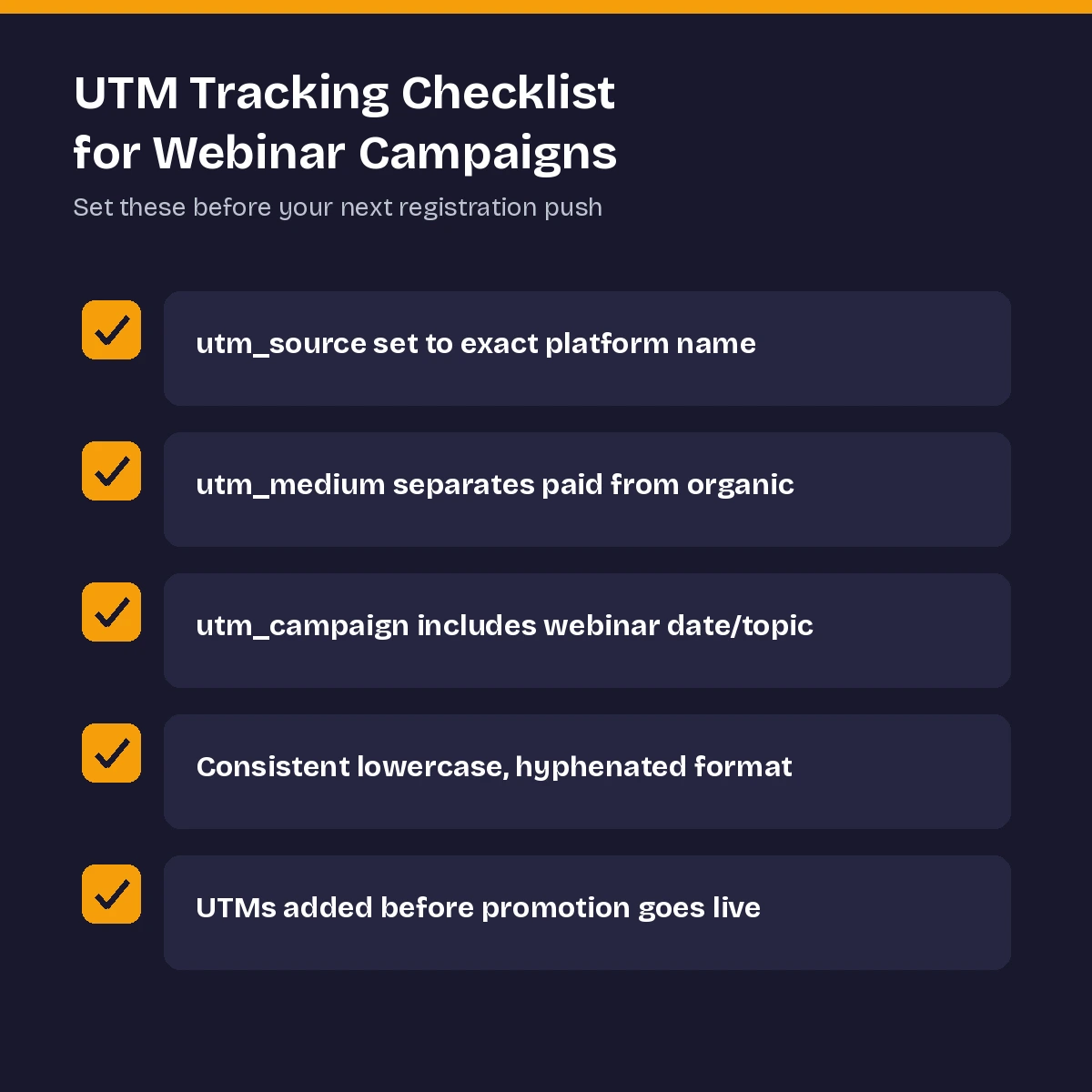
Clean attribution starts with clean tracking, and UTM parameters are still the backbone of that process. Every webinar promotion channel — email, paid social, organic social, partner newsletters — should carry a distinct, consistently formatted UTM so your analytics and CRM can tell them apart later.
Keep the format consistent: lowercase values, hyphens instead of spaces, and a naming convention your whole team actually follows. A registration link tagged utm_source=linkedin&utm_medium=paid-social&utm_campaign=2026-q1-webinar-attribution tells a very different story than one with inconsistent capitalization or missing parameters, even if both technically “work.” Sloppy UTM hygiene is one of the most common reasons webinar attribution data ends up unreliable months later, long after the campaign has ended and the mistake can’t be corrected retroactively.
Connecting Webinar Data to Your CRM
Attribution breaks down fast if webinar attendance data lives only in your webinar platform and never makes it into your CRM. At minimum, registration, attendance, and engagement data (polls answered, questions asked, time watched) should sync to the contact or lead record automatically, not through a manual export someone remembers to run once a quarter.
Inside most CRMs, this means webinars should be logged as a Campaign, with attendees linked through Campaign Member records, and ideally tied to an Opportunity Contact Role once a deal opens. Without that last link, even a well-tagged webinar campaign will show attendance numbers but fail to connect to actual revenue, which is usually the exact number leadership wants to see. Structuring this data properly is really an extension of good digital marketing reporting practices applied specifically to events. For guidance on evaluating whether your event program is worth the investment overall, this webinar lead nurturing guide covers how attendee data should flow into your broader lead scoring and nurture process.
Webinar Attribution Across the Funnel
Top of funnel — Webinars introducing broad industry topics often serve as first-touch or early-nurture content. Attribution here should focus on assisted conversions rather than direct close credit.
Middle of funnel — Product-focused or use-case-specific webinars frequently accelerate deals already in motion. This is where multi-touch models like U-shaped or W-shaped attribution earn their keep, since these events genuinely move accounts forward without being the final converting action.
Bottom of funnel — Customer-story or ROI-focused webinars aimed at accounts already in active evaluation can sometimes serve as a near-final touch, particularly when a decision-maker attends shortly before signing.
Segmenting your webinar program this way — rather than measuring every webinar with the same attribution lens — produces a far more honest picture of where webinars are actually earning their budget.
Common Webinar Attribution Mistakes
- Relying on last-click reporting, which almost always undervalues webinars since they rarely happen right before a deal closes
- Failing to connect webinar attendance to the account level, missing influence from other stakeholders on the same deal
- Inconsistent or missing UTM parameters that make channel-level analysis unreliable months later
- Treating every webinar the same, regardless of where it sits in the funnel
- Measuring only registration and attendance numbers instead of connecting data all the way through to closed revenue
How to Choose an Attribution Model for Your Webinar Program
- Count your deal volume. Fewer than 50 deals a year rarely justifies a complex model — a manual CRM review may be more accurate than algorithmic attribution at that volume.
- Map your sales cycle length. Cycles under 30 days can lean on simpler models; longer cycles benefit from multi-touch approaches that don’t erase mid-funnel influence.
- Audit your data quality first. No attribution model, however sophisticated, produces reliable answers on top of messy or incomplete tracking data.
- Start with W-shaped if you’re unsure. It’s a reasonable default for most B2B teams running webinars as part of a broader, multi-channel funnel.
- Revisit the model periodically. As your channel mix and sales cycle evolve, the attribution model that made sense a year ago may no longer reflect how deals are actually influenced today. Surfacing this in a live marketing dashboard rather than a static quarterly report makes it far easier to notice when your model needs adjusting.
Reviewing your program’s webinar content strategy alongside your attribution setup is worth doing at the same time, since the type of webinar you’re running should inform which stage of the funnel — and therefore which attribution weighting — makes the most sense for it.
Data Quality: The Foundation Attribution Depends On
No attribution model, no matter how sophisticated, can fix bad underlying data. Before investing time in choosing between U-shaped, W-shaped, or algorithmic attribution, it’s worth auditing a few basics: Are webinar registrations reliably matched to existing CRM contacts instead of creating duplicates? Are UTM parameters actually present on every promotional link, not just some of them? Is attendance data — not just registration — making it into your reporting?
A surprisingly large share of “broken” attribution turns out to be a data hygiene problem rather than a model problem. Teams that fix deduplication, standardize UTM naming, and ensure consistent field mapping between their webinar platform and CRM often see their attribution numbers become dramatically more trustworthy without changing the underlying model at all. This is also where webinar automation tools earn their value, since automating the sync between registration, attendance, and CRM records removes most of the manual steps where data quality tends to break down.
Tools That Support Webinar Attribution
Most teams don’t need a dedicated attribution platform to get started — a well-configured stack of existing tools often gets you 80% of the way there. A marketing automation platform that logs campaign membership, a CRM with Campaign Influence or an equivalent multi-touch feature, and a webinar platform that exports attendance and engagement data cleanly are usually enough to build a credible multi-touch attribution model.
Dedicated attribution platforms and revenue-intelligence tools become more valuable once deal volume grows large enough that manual review is impractical, or once leadership wants algorithmic, statistically-validated credit assignment rather than a fixed-weight model like W-shaped attribution. Until then, the combination of clean UTM tracking, consistent CRM logging, and one of the standard multi-touch models covered earlier will answer most of the questions your team actually needs answered.
Webinar attribution isn’t about proving webinars are always the hero of every deal — it’s about giving them fair, honest credit for the specific role they actually play in a longer, multi-touch B2B journey. Simple first-touch or last-touch models tend to undervalue webinars precisely because of where they usually sit in the funnel: influential, but rarely the very first or very last interaction.
Getting this right starts with clean UTM tracking, a CRM setup that connects webinar activity to accounts and opportunities, and an attribution model — usually something in the multi-touch family — that reflects how your specific sales cycle actually works. Teams that invest in this measurement infrastructure stop guessing whether their webinar program is worth the budget, and start knowing.
Frequently Asked Questions About Webinar Attribution
1. What Is Webinar Attribution?
Webinar attribution is the process of measuring how much credit a webinar deserves for influencing a lead, opportunity, or closed deal as part of a broader marketing attribution strategy.
2. Why Does Last-Touch Attribution Undervalue Webinars?
Webinars rarely happen as the final interaction before a deal closes. As a result, last-touch models may assign them little or no credit even when they played a meaningful role earlier in the customer journey.
3. Which Attribution Model Works Best for Webinars?
Multi-touch models such as U-shaped or W-shaped attribution can be useful because they distribute credit across multiple touchpoints rather than assigning it entirely to one interaction.
4. How Do UTM Parameters Help With Webinar Attribution?
UTM parameters allow analytics and CRM systems to distinguish between promotional channels. This makes it easier to identify which sources generated registrations, attendance, engagement, and eventual conversions.
5. Should Webinar Attribution Happen at the Contact or Account Level?
Both can be useful, but account-level attribution is particularly important in B2B marketing. Multiple stakeholders within the same account may interact with different touchpoints, including webinars.
6. How Much Deal Volume Do I Need for Algorithmic Attribution?
There is no universal deal-volume threshold. Algorithmic or data-driven attribution generally requires sufficient conversion volume, consistent tracking, and high-quality historical data to produce reliable insights.
7. Can Small Marketing Teams Do Webinar Attribution Without Expensive Tools?
Yes. A well-configured CRM with clean UTM tracking and campaign influence features can support useful multi-touch attribution without requiring dedicated attribution software.
8. Does Webinar Attribution Differ for Top-of-Funnel Versus Bottom-of-Funnel Events?
Yes. Top-of-funnel webinars are often evaluated through assisted conversions and pipeline influence, while bottom-of-funnel webinars closer to a purchase decision may have a more direct relationship with conversions.
9. What’s the Biggest Mistake Teams Make With Webinar Attribution?
Relying solely on last-click reporting is a common mistake because it can undervalue webinars that influenced prospects earlier in the buying journey.
10. How Often Should I Revisit My Attribution Model?
Review your attribution model whenever your channel mix, sales cycle, customer journey, or data quality changes significantly. A model that works at one stage of business growth may need adjustment later.
11. Does Webinar Attendance Need to Sync Automatically to My CRM?
Automatic syncing is highly useful because it keeps registration, attendance, and engagement data connected to individual contacts and accounts. This reduces the reliability issues associated with repeated manual exports.
12. Can Webinar Attribution Prove ROI to Leadership?
Yes. When webinar data is connected through to pipeline and closed revenue, attribution reporting can help demonstrate which webinar topics, formats, and promotional channels are contributing to business outcomes.














No Comments